Tons of snow would hold up trains on their travels through the Stevens Pass as the passage would become over burdened with the accumulations coming off of the mountains. It was in March of 1910 that the winter weather in the pass would show the Great Northern Railway exactly what it could be capable of.
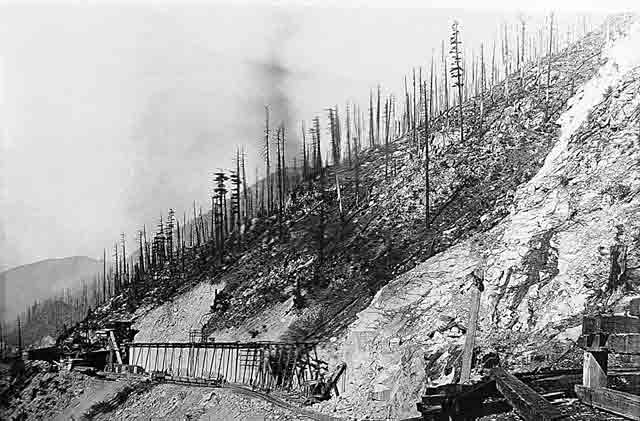 |
| The construction of the Great Northern Railway through Stevens Pass in the late 1890s |
 |
| The rail depot at Wellington, WA around 1900 |
 |
| Stevens Pass at Wellington shortly after the avalanche of 1910 |
 |
| Two of the locomotives can be seen buried in the snow along with some of the other wreckage of the Wellington Depot after the avalanche of 1910 |
 |
| The destructive power of the Wellington avalanche can be seen in this photo taken shortly afterward. Workers can be seen working through the mangled train cars, trees, and snow looking for survivors. |
 |
| The Wellington avalanche victims had to be taken out by sled as it took 12 days to dig out the tracks |
A short while after the disaster, the Great Northern Railroad began to build concrete and steel snow tunnels to protect the trains from the avalanches. One three quarters of a mile long was constructed at the site of the Wellington avalanche. The town of Wellington did not want it's name to be associated with the disaster and changed it's name to Tye. Eventually, the new eight mile long Cascade tunnel was built so that trains could pass safely under Stevens Pass. This spelled the end of Tye and all that remains today is the concrete snow bunker which now serves as a monument to the disaster of 1910.
 |
| All that remained after the town of Tye (formerly Wellington) closed were the rail depot building and the snow sheds in the background at the site of the avalanche of 1910. |
 |
| Today Iron Goat Trail goes through the old snow sheds constructed to protect the railway tracks which no longer exist |
 |
| The old rail tunnel along the Iron Goat Trail can be a creepy place to hike through given the torrid history of how they got there |
 |
| The Iron Goat Trail can also be a very beautiful place to hike |
The Wellington site can be accessed via the Iron Goat Trail which is named after the nickname of the Great Northern Railroad of which the trail was built on. Some travelers along this trail claim that the victims of the Wellington avalanche are still there. There have been reports of disembodied voices echoing through the avalanche tunnel when no one else is there or no one else accompanying them has spoken. Strange feelings of hair raising on end and cold spots have been reported. Many reports have centered around the bridge that stands near the site of the old railroad depot. Some people have claimed to have actually heard the sounds of a phantom avalanche with the rumbling, trees snapping, and the sound of metal crushing. So take a hike on the Iron Goat Trail and see if you encounter the ghosts of Wellington.
 |
| Cascade Mountains on Dwellable |

