Ghost stories, haunted places, and the paranormal from the northwestern United States including Oregon, Washington, Idaho, Montana, Wyoming and Alaska.
Showing posts with label Washington. Show all posts
Tuesday, October 22, 2013
Ghosts of Thornewood Castle - Lakewood Area of Tacoma, Washington
Chester Thorne was one of the founders of Tacoma, Washington. In 1907, as a gift for his bride, he purchased an English castle which was physically located in England, and had it dismantled and shipped brick by brick to the shores of American Lake where it was reassembled into what would become Thornewood Castle. Chester put so much time, effort and devotion into his new mansion that some say he is still there.
If you recognize this castle, it may be because it was the mansion featured in the movie based on the Stephen King thriller "Rose Red". It was also used in the prequel to the movie "The Diary of Ellen Rimbauer". Although the real hauntings of the castle are a bit different than that of the movie.
Over the years, some of the staff at the castle has claimed to see a man dressed in turn of the century riding attire walking about the lawn. Chester Thornewood liked to ride of course and many who have seen this figure believe it is the ghost of Mr. Thornewood himself. He has also been seen inside the mansion on occasion wearing the same riding outfit.
Chester's wife Anna Thornewood has also been reported as being seen in the old castle. She has mostly been seen standing in the windows of what used to be her old bedroom. Guests of the mansion's bread and breakfast have been walking in the gardens and have seen the figure of a woman in period clothing peering out of the windows. Perhaps she is waiting for Chester to return from his horse back ride.
The spirit of Mr. and or Mrs. Thornewood showed itself during a major restoration project at the castle. It seems that either Chester or Anna fussed over the lighting and glassware choices made by the current castle owners. It seems that in the evening, he would break light bulbs and glassware as if to say he did not like them. After a change was made, the disruptive behavior stopped. There are occasions when glass can be heard breaking, but no evidence is ever found that there was any physical damage done. Perhaps it is the ghosts of the Thornwoods letting everyone know who is in charge. It sounds tempting to book a room and see if one can catch a glimpse of the Ghosts of Thornewood Castle.
Location:
The Lakewood suburb of Tacoma
Latitude 47.130094, Longitude -122.551252
8601 N Thorne Ln SW
Tacoma, WA 98498
References:
http://www.thornewoodcastle.com
http://en.wikipedia.org/wiki/Thornewood_Castle
Saturday, September 10, 2011
Ghosts of Wellington on the Iron Goat Trail - Skykomish, Washington
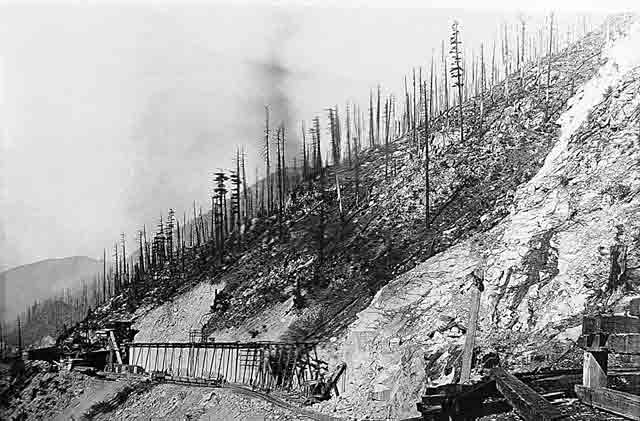
In the late 1890s The Great Northern Railway completed a rail line through the mountains of Washington State that cut through Steven's Pass deep in the Cascade Mountains, linking Seattle with the Mid-west. Engines had to labor up the mountain pass through switchbacks, sharp curves, and steep grades with the assistance of helper engines as well. A tunnel that emerged on the western side of the pass at Wellington eased the burden on the engines, however one thing that the railway had a hard time conquering was the winter.
Tons of snow would hold up trains on their travels through the Stevens Pass as the passage would become over burdened with the accumulations coming off of the mountains. It was in March of 1910 that the winter weather in the pass would show the Great Northern Railway exactly what it could be capable of.
After a savage storm that lasted 9 days and dropped at times a foot of snow an hour, a west bound passenger train had to hold up at the Wellington depot to wait for the snow to be cleared. An eastbound mail train also had to sit out the storm along side of the passenger train. Unfortunately for the occupants of the two trains, the snow had turned to rain making the snow very heavy and it is believed lightening struck near to top of Windy Mountain just above the town of Wellington. This strike triggered the heavy snow to begin to slide down the mountain snapping of trees and moving huge boulders very quickly down the mountain side towards the sleeping passengers and train crews in a half mile long and quarter mile wide moving mass of destruction.
As the avalanche reached Wellington, it barely missed the town but struck the train depot as well as the two fully loaded trains as they sat waiting. The cars were pushed off the tracks and swept down the mountain side, the combination of the heavy snow, snapped off trees and boulders crushing the cars and their occupants. The wreckage was strewn all over the mountain and into Tye Creek at the bottom. In all, 96 people lost their lives that night as only 26 survivors were pulled from the carnage. The bodies had to be removed via sled. It took twelve days to dig the snow away from the tracks. Some bodies took over four months to recover. It was the worst and to this date, the most devastating avalanche in the United States.
A short while after the disaster, the Great Northern Railroad began to build concrete and steel snow tunnels to protect the trains from the avalanches. One three quarters of a mile long was constructed at the site of the Wellington avalanche. The town of Wellington did not want it's name to be associated with the disaster and changed it's name to Tye. Eventually, the new eight mile long Cascade tunnel was built so that trains could pass safely under Stevens Pass. This spelled the end of Tye and all that remains today is the concrete snow bunker which now serves as a monument to the disaster of 1910.
The Wellington site can be accessed via the Iron Goat Trail which is named after the nickname of the Great Northern Railroad of which the trail was built on. Some travelers along this trail claim that the victims of the Wellington avalanche are still there. There have been reports of disembodied voices echoing through the avalanche tunnel when no one else is there or no one else accompanying them has spoken. Strange feelings of hair raising on end and cold spots have been reported. Many reports have centered around the bridge that stands near the site of the old railroad depot. Some people have claimed to have actually heard the sounds of a phantom avalanche with the rumbling, trees snapping, and the sound of metal crushing. So take a hike on the Iron Goat Trail and see if you encounter the ghosts of Wellington.
Tons of snow would hold up trains on their travels through the Stevens Pass as the passage would become over burdened with the accumulations coming off of the mountains. It was in March of 1910 that the winter weather in the pass would show the Great Northern Railway exactly what it could be capable of.
![]() |
| The construction of the Great Northern Railway through Stevens Pass in the late 1890s |
![]() |
| The rail depot at Wellington, WA around 1900 |
![]() |
| Stevens Pass at Wellington shortly after the avalanche of 1910 |
![]() |
| Two of the locomotives can be seen buried in the snow along with some of the other wreckage of the Wellington Depot after the avalanche of 1910 |
![]() |
| The destructive power of the Wellington avalanche can be seen in this photo taken shortly afterward. Workers can be seen working through the mangled train cars, trees, and snow looking for survivors. |
![]() |
| The Wellington avalanche victims had to be taken out by sled as it took 12 days to dig out the tracks |
A short while after the disaster, the Great Northern Railroad began to build concrete and steel snow tunnels to protect the trains from the avalanches. One three quarters of a mile long was constructed at the site of the Wellington avalanche. The town of Wellington did not want it's name to be associated with the disaster and changed it's name to Tye. Eventually, the new eight mile long Cascade tunnel was built so that trains could pass safely under Stevens Pass. This spelled the end of Tye and all that remains today is the concrete snow bunker which now serves as a monument to the disaster of 1910.
![]() |
| All that remained after the town of Tye (formerly Wellington) closed were the rail depot building and the snow sheds in the background at the site of the avalanche of 1910. |
![]() |
| Today Iron Goat Trail goes through the old snow sheds constructed to protect the railway tracks which no longer exist |
![]() |
| The old rail tunnel along the Iron Goat Trail can be a creepy place to hike through given the torrid history of how they got there |
| The Iron Goat Trail can also be a very beautiful place to hike |
The Wellington site can be accessed via the Iron Goat Trail which is named after the nickname of the Great Northern Railroad of which the trail was built on. Some travelers along this trail claim that the victims of the Wellington avalanche are still there. There have been reports of disembodied voices echoing through the avalanche tunnel when no one else is there or no one else accompanying them has spoken. Strange feelings of hair raising on end and cold spots have been reported. Many reports have centered around the bridge that stands near the site of the old railroad depot. Some people have claimed to have actually heard the sounds of a phantom avalanche with the rumbling, trees snapping, and the sound of metal crushing. So take a hike on the Iron Goat Trail and see if you encounter the ghosts of Wellington.
![]() |
| Cascade Mountains on Dwellable |
Subscribe to:
Posts (Atom)