Tuesday, October 29, 2013

Mary's Ghost of the Golden North Hotel - Skagway, Alaska

Around the end of the 19th century, one of the first hotels known in the Alaskan wilderness was built in Skagway, Alaska.  A young gold prospector and his fiancé Mary came to the area looking for fortune.  He got Mary a room at the Golden North Hotel until he could find enough gold to establish a homestead of their very own.  That unfortunately, would never happen.


The ghost of Mary, a bride to be, haunts the Golden North Hotel where she died waiting for her fiancé to return from a prospecting trip.

After Mary's fiancé headed back out to collect his fortune in gold, she became very ill with pneumonia.  She languished in room 23, waiting for her love to return, but tragically she passed away before he did.  The two lovers would be forever parted.

From that point on, many guests in the hotel that stayed in room 23 have awakened with the sensation of being choked as if by some unseen hands.  Others have actually seen the apparition of a young woman dressed in turn of the century attire, standing in the room with them.  The ghostly figure would then disappear.

Below in room 14, there are other unworldly experiences reported by guests.  Most refer to a bizarre light they have seen floating around the room which seems to be shimmering.  Many witnesses describe it to be in the shape of a ball.  Whether it is related to Mary's ghost, it is unknown.

The Golden North Hotel building still stands to this day, however it is no longer operating as a hotel.  The hotel sign still remains, but the building contains shops and the upper floors remain unoccupied.  Except for Mary that is...


Location:
3rd & Broadway
Skagway, Alaska


Tuesday, October 22, 2013

Ghosts of Thornewood Castle - Lakewood Area of Tacoma, Washington


Chester Thorne was one of the founders of Tacoma, Washington.  In 1907, as a gift for his bride, he purchased an English castle which was physically located in England, and had it dismantled and shipped brick by brick to the shores of American Lake where it was reassembled into what would become Thornewood Castle.  Chester put so much time, effort and devotion into his new mansion that some say he is still there.

Thornewood Castle under construction in 1910.  It would later be feature in the Stephen King film Rose Red. In real life, the ghost of the former owner of the stately mansion is said to walk the grounds to this day.
Thornewood Castle under construction in 1910.  It would later be feature in the Stephen King film Rose Red. In real life, the ghost of the former owner of the stately mansion is said to walk the grounds to this day.

If you recognize this castle, it may be because it was the mansion featured in the movie based on the Stephen King thriller "Rose Red". It was also used in the prequel to the movie "The Diary of Ellen Rimbauer".  Although the real hauntings of the castle are a bit different than that of the movie.

Over the years, some of the staff at the castle has claimed to see a man dressed in turn of the century riding attire walking about the lawn. Chester Thornewood liked to ride of course and many who have seen this figure believe it is the ghost of Mr. Thornewood himself.  He has also been seen inside the mansion on occasion wearing the same riding outfit.

Chester's wife Anna Thornewood has also been reported as being seen in the old castle. She has mostly been seen standing in the windows of what used to be her old bedroom.  Guests of the mansion's bread and breakfast have been walking in the gardens and have seen the figure of a woman in period clothing peering out of the windows.  Perhaps she is waiting for Chester to return from his horse back ride.

The spirit of Mr. and or Mrs. Thornewood showed itself during a major restoration project at the castle. It seems that either Chester or Anna fussed over the lighting and glassware choices made by the current castle owners.  It seems that in the evening, he would break light bulbs and glassware as if to say he did not like them.  After a change was made, the disruptive behavior stopped.  There are occasions when glass can be heard breaking, but no evidence is ever found that there was any physical damage done.  Perhaps it is the ghosts of the Thornwoods letting everyone know who is in charge. It sounds tempting to book a room and see if one can catch a glimpse of the Ghosts of Thornewood Castle.

Location:
The Lakewood suburb of Tacoma
Latitude  47.130094, Longitude  -122.551252
8601 N Thorne Ln SW
Tacoma, WA 98498

References:
http://www.thornewoodcastle.com
http://en.wikipedia.org/wiki/Thornewood_Castle


Tuesday, October 8, 2013

Phantom Miner of Slaughterhouse Gulch - Battle Lake, Wyoming

During the 19th century, the hills near the Wyoming/Colorado Border were bustling with mining activity.  Many made their way into the mountains near Battle Lake to work in the copper and coal mines to seek their fortunes. However, one miner who had been working in an area known as Slaughterhouse Gulch was not so fortunate.

A depiction of how the phantom of Slaughterhouse Gulch may appear if he is encountered in the mountains near Battle Lake, Wyoming. Ghost of Slaughterhouse Gulch
A depiction of how the phantom of Slaughterhouse Gulch may appear if he is encountered in the mountains near Battle Lake, Wyoming.

The miners, as many did in the day used explosives to speed up their efforts. One day things went awry for one particular fellow and he managed to blow himself up along with the mine. There was nothing left of him to even bury.  It was over the time period after that which led to stories coming in of strange encounters with a man resembling a miner wandering the trail between Encampment and the ghosts town of Battle.  This phantom became known by locals as The Ghost of Slaughterhouse Gulch.  One stage coach driver claimed that he approached a stranger on the road and his horses went berzerk.  They were deathly afraid of the man.  He walked right at the front of the team and coach without wavering and strolled right through the horses and into thin air!

In the early 1900s, a group of forestry workers were camped out along the trail in Slaughterhouse Gulch warming themselves by their campfire when suddenly they saw a man wandering down the road in the darkness in the light of the fire. He just strolled on by, it appeared that he had no supplies and having been a long walk to the nearest town, didn't even stop and ask for food or drink.  Those at the campfire found this very bizarre.  And what they found even more strange was that not only did he not knowledge that they were there, they didn't hear his footsteps as he walked by.  The Ghost of Slaughterhouse Gulch had made another appearance it seemed. Some say that he wanders the hills and trails for all eternity searching for the peace that he never received from receiving a proper burial.


Battle Lake is nestled in the Sierra Madre Mountain range in Carbon County, Wyoming near the Colorado border.  Photo credit: http://www.flickr.com/photos/carboncountywy/

Slaughterhouse Gulch lies in the mountains of Carbon County, Wyoming just north of the Colorado Border in the Medicine Bow National Forest. Easiest access is via Highway 70 that crosses the Sierra Madre.  However, it is closed in the winter. Battle Lake is near latitude: 41.159130, longitude: -107.008708 along highway 70.


Friday, September 6, 2013

Phantom Horse Thief of Scaponia Park - Veronia, OR

Long ago in the late 19th century there was a man who as many drifters back in the day did, made a living by stealing horses and selling them.  The stranger who's name remains unknown, had a small dog as his companion.  After a while, locals caught onto what the man and his dog were up to.

The banks of the Nehalem River area where the ghost of a horse thief and his dog are said to haunt near Veronia, Oregon
The banks of the Nehalem River area where the ghost of a horse thief and his dog are said to haunt near Veronia, Oregon.


About 12 miles west of St Helens, Oregon near the town of Veronia, the horse thief met his end along the banks of the Nehalem River just East of town.  For some reason, the lynch mob were so overcome with anger, they shot the man's dog as well.  They buried both of them together there on the banks of the river under an oak tree.

It is said that on certain nights, a shadowy figure of a man and his dog can be seen wandering along the banks of the Nehalem River in an area what is now known as Scaponia Park located along the Scappoose-Veronia Road.  Many campers have claimed to have seen the ghostly duo in the campground there, perhaps looking for a horse or two to steal in the afterlife.

Scaponia County Park
Scappoose-Vernonia Road
Vernonia, Oregon
(503) 397-2353

Park website:
http://www.co.columbia.or.us/departments/county-parks/scaponia


Sunday, October 28, 2012

The Hennessy Mansion in Butte, Montana

Just after the turn of the century in the early 1900s, wealthy and prominent businessman Daniel Hennessy built a grand home for his family in northwest Butte, Montana.  Over thirteen thousand square feet, it was a well known landmark in Butte.  It would become even more well known over the years s Daniel Hennessy seems to have never left his beloved home, even in death.

The Hennessy Mansion in Butte, Montana is reportedly haunted by it's original owner

Daniel Hennessy owned a chain of department stores and built a fortune, prospering in the Butte area. He later also became a senator, serving his district for the state of Montana.  He constructed a granite brick mansion where he moved his wife Mary and their three children.


The grave marker of Daniel Hennessy and his wife Mary

After Daniel and his wife passed away, and their children moved on, the property eventually changed hands and at some point served as a fraternity house and then again, a private residence.  It is said that over the years a ghostly apparition believed to be that of Daniel Hennessy, has been seen roaming throughout the stone mansion.  Most commonly his spirit is seen in the basement area as well as the other parts of the house.  Occasionally footsteps have been heard on the basement stairs. Most often he is seen standing on the stairway to the lower level of the mansion.  Perhaps this was Daniel's favorite place to hang out when he lived in the home...  and in death, his favorite haunt.


The house still stands today as a private residence.


Saturday, October 13, 2012

Blue Girl of Ammon Park - Pocatello, Idaho

In the town of Pocatello, Idaho there is a small park that is very typical looking in every way.  People come and go, walk their dogs, and children play on the playground.  There is one child in particular though that has been seen on the playground that is most unlike the others.  She is a ghost!


A little girl in blue has been swinging on the playground at Ammon Park in Pocatello, Idaho.  However, she disappears in the blink of an eye.
A little girl in blue has been swinging on the playground at Ammon Park in Pocatello, Idaho.  However, she disappears in the blink of an eye.

Many visitors to Ammon Park have reported seeing what to them appears to be a little girl in a blue dress swinging on the swings.  However, this girl seems to disappear into thin air.  There are others who say they simply saw a quick flash of blue near the swings and then when they looked again, there was nothing but an empty swing.

There also seems to be some strange activity related to a tool shed that is on the park grounds.  There are those who speculate that this may be the spot where this young girl perished, leaving her spirit behind.  The latched shed door has been known to open on it's own accord, with no wind blowing whatsoever.  One visitor to the park reported being locked in this shed by unseen hands with her friend when they were young. 


Sightings of the ghost of Ammon Park also have been centered around a particular tree that phantom girl in the blue dress likes to hide behind.  Sort of like she is playing hide and seek. Some who enter the park only sense her presence, feeling watched by unseen eyes,  perhaps from behind this tree.

Others have been to Ammon Park and have heard voices and even children's laughter when he park was seemingly empty.  There have also reports of energy drain phenomenon on cameras and other devices within a short time of being within the park grounds.


Ammon Park in Pocatello, Idaho is haunted by the spirit of a little girl.  Photo from Google Earth.
Ammon Park in Pocatello, Idaho is haunted by the spirit of a little girl.  Photo from Google Earth.

Ammon Park is at the intersection of Homer Drive And Ammon St. in Pocatello, Idaho in Bannock Count just next to route 15. Take a visit to this little getaway and see if you see or feel The Blue Girl of Ammon Park.


Wednesday, October 10, 2012

Children of Birch Hill Cemetery - Fairbanks, Alaska (White Lady of Birch Hill)

Overlooking the city of Fairbanks, Alaska is the Birch Hill Cemetery which provides a great view of the town.  However, it is also well known around Fairbanks for another reason.  It is believed to be haunted by the spirits of children.


The misty figure in this photo taken by paranormal researcher Jessie Desmond, is a supposed ghost in Birch Hill Cemetery located in Fairbanks, Alaska

The full bodied apparition of a young boy has been seen wandering about the cemetery.  It is believed that this boy is from the early 1900s based on the type of clothing he is wearing.  This apparition is often seen just wandering around the cemetery as if looking for someone.  He does however, have company.  The most famous ghost of Fairbanks, Alaska, also resides in this location.  A young girl is often seen wandering through the graveyard wearing a white dress.  Witnesses say she is also dressed according to early 1900s fashion. She is commonly referred to as The White Lady of Birch Hill.  She was reportedly photographed on one occasion by paranormal researcher Jessie Desmond.


A few visitors to the cemetery have spotted a small dark figure floating just above the ground moving about the cemetery as if it were looking for something or perhaps playing.  Shadow figures have been known to be malevolent spirits, however there have been no reports of anything torrid happening to those witnessing this dark spirit.  

 
The ghost children of Birch Hill also seem to possibly take another form.  There are witnesses driving along Chena Hot Springs Road who look upon Birch Hill and see strange glowing orbs hovering the air above the cemetery. Sometimes, hovering, sometimes moving, seemingly dancing around, and some say they seem to radiate light. Could it be that these orbs are the spirits of the young children playing around?  Perhaps so.


A view of Fairbanks, Alaska taken from Birch Hill Cemetery where strange orbs and apparitions have been seen by visitors and passers by.

It may be that these youngsters are victims of the 1918 influenza epidemic that hit Fairbanks.  Many died being isolated in the Arctic with lack of medicine when the epidemic struck.  No matter how they died, they wander in death among the grave markers, perhaps searching for a life they never knew.


Monday, October 17, 2011

Legend of the Platte River Death Ship - Wyoming

Along the banks of the Platte River in Wyoming, a legend has been passed on since the mid 1800s.  A legend of an spectral nature.  Several witnesses have claimed to see a phantom ship on the Platte River.  They say that an eerie mist will begin to form on the river and slowly the mist will form a bank of fog that only covers a small area.  Out of the fog will then emerge a sailing ship from days gone by, appearing grey and unnatural, manned by phantom sailors.  This vessel has become known as, "The Ship of Death".

A old sailing ship is said to appear out of an eerie fog bringing an omen of death for the lone person that lays eyes on the vessel

The ship got it's ominous name not from the ghosts that man it, but the fact that it brings an omen of death to someone known to the person who witnesses it's appearance.  The first reported sighting in 1862 was by a trapper by the name of Leon Webber who saw the phantom ship. As he got a clear view of the top deck, he saw the body of his fiancé laying on a piling on the deck. That same day, his fiancé passed away. 

Twenty five years after the Webber sighting, a cattleman was working a herd along the Platte River when he saw an unusual fog and a ship crewed by ghosts emerge. The ship seemed to shimmer as it moved through the mist.  On the deck of the ship, what appeared to be the spectral form of his wife was layed out as if sleeping.  That same day his wife died.

The last reported sighting was in 1903.  A man who lived along the Platte River was trimming and removing trees in his yard one Fall day.  He too saw the phantom ship appear in a sudden fog.  Again, it appeared to be manned by a crew of ghosts and laying on the deck of the ship was a good friend of his.  And of course, his friend passed away that day.


If you are ever along the banks of the Platte River in Wyoming and you see a spectral sailing vessel emerging from an eerie fog, avert your eyes lest someone you know be the next claimed by the Ship of Death.

Friday, October 14, 2011

Spirits of Little Bighorn - Little Bighorn Valley in Southern Montana

In the plains of southern Montana in 1876, a long and bloody war between the U.S. Army and the Native Americans of the western plains known as the Black Hills War or The Great Sioux War culminated in a battle at a valley known as Little Bighorn.  The 7th Calvary Army forces which numbered over 700 were led by General George Armstrong Custer and were grossly outnumbered by over 1800 warriors of the combined forces of Lakota, Northern Cheyenne, and Arapaho tribes.  


Artist's depiction of Custer's Last Stand at Little Bighorn 1876

In the aftermath of the battle, 268 cavalrymen and over 100 native warriors and many horses lay dead on he field.  Many of the soldier's were mutilated beyond recognition while the warriors were gathered up by their tribesman and taken away for a proper burial.  The natives believed that these fallen soldiers would never rest.


The aftermath of the Battle of Little Bighorn.  Remains of horses litter the prairie which were later interred along with the soldiers. A memorial marks their resting place at Little Bighorn National Monument.
Last Stand Hill in 1894

Five of the the 7th Calvary's companies were totally wiped out leaving 268 U.S. Soldiers dead including General George Armstrong Custer himself.  It is believed that in Custer's individual battle, American soldiers numbered just over 200 and encountered the entire combined Native American force.  This individual battle would become known as Custer's Last Stand.  This spot is marked on what is today known as Last Stand Hill.  It is said that a man once encountered the spirit of General Custer at this spot who spoke to him about details of the battle.  Custer's apparition has been spotted near and in the visitor's center at the foot of Last Stand Hill along with a rush of cold air.


General George Armstrong Custer who met his end at the Battle of Little Bighorn

One of Custer's cavalrymen, Second Lieutenant Benjamin Hodgson, died a terrible death near the crossing of Little Big Horn River where his body was found.  A monument marks the spot where he was found.  Hodgson's ghost has been seen in various places, but most notably in and around the stone house which now serves as the park's superintendent's quarters.  One evening it is said that a park employee awoke to find an apparition sitting at the kitchen table.  Sometime afterward, she saw a photo of a soldier who wore a long distinguished mustache, the employee exclaimed that the man in the photo was the ghost that was in the kitchen.  It was a photo of Benjamin Hodgson.


Second Lieutenant Benjamin Hodgson died a terrible death at the Battle of Little Bighorn.  A memorial marks the spot where he fell as well as many other soldiers and Native Americans who fought and died.

There have been several visitors who claim to have seen Native American warriors in full attire sitting on their horses on top of a bluff.  Some have seen them riding over the hills then disappearing into thin air.  Others have heard the sounds of battle, the shouts of the warriors along with gun fire.  Many of these occurrences have happened at the local cemetery.


Crazy Horse was one of the Native Americans who fought at the Battle of Little Bighorn.  He survived the battle.
Markers indicate where soldiers fell during the Battle of Little Bighorn

Park employees were not the fist to see the dead roaming the plains of Little Bighorn.  The people of the Crow tribe have believed for years that the spirits of the Little Bighorn would rise at night then return to the the netherworld when the sun rose again.  When the park was established, they nicknamed the park attendant the "ghost herder" symbolizing that when they lowered the flags at sundown, the ghosts would come, then disappear when the attendant would raise the flag at dawn.  This would in a sense, send the dead back to the spirit world.

Saturday, September 24, 2011

Haunted Standrod Mansion - Pocatello, Idaho

D.W. Standrod was a well to do lawyer and business man in Pocatello, Idaho which is just south west of Idaho Falls.  With his wealth, in 1902 he built a beautiful Chateauesque  style mansion which was modeled after it's French counterparts. He lived in the mansion with his wife Emma and his two children, daughter Cammie and son Drew.


The Standrod Mansion - Pocatello, Idaho in the early 1900s

It is said that Cammie, who was 16 at the time, became involved with a young boy whom she fell in love with.  Her father upon hearing of her relationship with this young man who was not of the same stature as his family, did not approve.  Shortly afterward, the boy disappeared.  It is unknown what happened to him.  Cammie was distraught from the ordeal and locked herself in her room which was the turret room in the tower of the mansion.  She had been for some time already been weakened by a kidney disease. Unfortunately, she caught a cold and in her weak and distraught state, succumbed to the illness and died on April 27, 1906.

Drew Standrod had died of illness at an fairly early age as well when he was out of town.  D.W. Standrod himself
succumbed to disease some years later at the age of 84 and he himself passed away in the mansion. His wife Emma lived to be 98 before she passed on.


The Standrod Mansion - Pocatello, Idaho as it appears today

After the deaths of the Stanrods, the house passed to Drew's widow who left it sit idle for many years before she finally sold it in 1957.  Over the years it passed ownership many times, including the City of Pocatello which used it to hosts banquets and such and the mansion was once even used as a furniture store.  Various occupants and visitors to the mansion have one thing in common.  As soon as they entered the mansion, they felt an eerie presence.  Some say they suddenly felt ill. Many believe this is the spirit of Cammie Standrod still trapped in the mansion due to her untimely death.  Some claim to have actually seen her apparition in the tower windows and on certain occasions lingering on the tower roof. 
Apparently, Cammie is not the only Stadrod who refuses to leave the mansion.  On a rare occasion, the apparition of an old man has been seen sitting on a chair on the side porch of the old mansion.  And there have been reports of seeing a young boy dressed in turn of the century attire sitting in the dining room.  Perhaps it is the spirit of Drew Standrod revisiting his childhood home.

Saturday, September 10, 2011

Ghosts of Wellington on the Iron Goat Trail - Skykomish, Washington

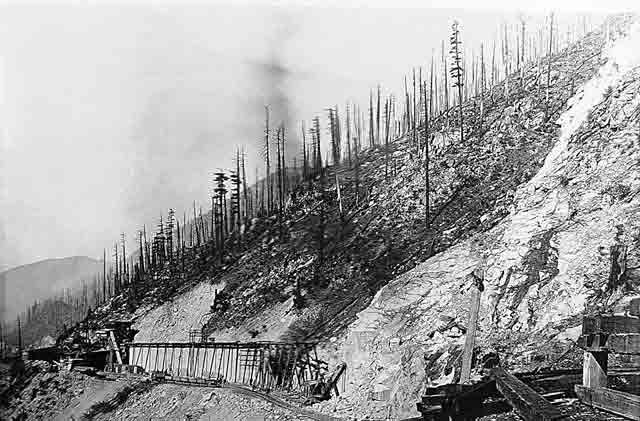
In the late 1890s The Great Northern Railway completed a rail line through the mountains of Washington State that cut through Steven's Pass deep in the Cascade Mountains, linking Seattle with the Mid-west.  Engines had to labor up the mountain pass through switchbacks, sharp curves, and steep grades with the assistance of helper engines as well.  A tunnel that emerged on the western side of the pass at Wellington eased the burden on the engines, however one thing that the railway had a hard time conquering was the winter. 
Tons of snow would hold up trains on their travels through the Stevens Pass as the passage would become over burdened with the accumulations coming off of the mountains.  It was in March of 1910 that the winter weather in the pass would show the Great Northern Railway exactly what it could be capable of.  


The construction of the Great Northern Railway through Stevens Pass in the late 1890s

The rail depot at Wellington, WA around 1900
After a savage storm that lasted 9 days and dropped at times a foot of snow an hour, a west bound passenger train had to hold up at the Wellington depot to wait for the snow to be cleared.  An eastbound mail train also had to sit out the storm along side of the passenger train.  Unfortunately for the occupants of the two trains, the snow had turned to rain making the snow very heavy and it is believed lightening struck near to top of Windy Mountain just above the town of Wellington.  This strike triggered the heavy snow to begin to slide down the mountain snapping of trees and moving huge boulders very quickly down the mountain side towards the sleeping passengers and train crews in a half mile long and quarter mile wide moving mass of destruction.


Stevens Pass at Wellington shortly after the avalanche of 1910

As the avalanche reached Wellington, it barely missed the town but struck the train depot as well as the two fully loaded trains as they sat waiting.  The cars were pushed off the tracks and swept down the mountain side, the combination of the heavy snow, snapped off trees and boulders crushing the cars and their occupants. The wreckage was strewn all over the mountain and into Tye Creek at the bottom. In all, 96 people lost their lives that night as only 26 survivors were pulled from the carnage.  The bodies had to be removed via sled.  It took twelve days to dig the snow away from the tracks.  Some bodies took over four months to recover.  It was the worst and to this date, the most devastating avalanche in the United States.
Two of the locomotives can be seen buried in the snow along with some of the other wreckage of the Wellington Depot after the avalanche of 1910
The destructive power of the Wellington avalanche can be seen in this photo taken shortly afterward.  Workers can be seen working through the mangled train cars, trees, and snow looking for survivors.
The Wellington avalanche victims had to be taken out by sled as it took 12 days to dig out the tracks

A short while after the disaster, the Great Northern Railroad began to build concrete and steel snow tunnels to protect the trains from the avalanches.  One three quarters of a mile long was constructed at the site of the Wellington avalanche. The town of Wellington did not want it's name to be associated with the disaster and changed it's name to Tye. Eventually, the new eight mile long Cascade tunnel was built so that trains could pass safely under Stevens Pass.  This spelled the end of Tye and all that remains today is the concrete snow bunker which now serves as a monument to the disaster of 1910.


All that remained after the town of Tye (formerly Wellington) closed were the rail depot building and the snow sheds in the background at the site of the avalanche of 1910.


Today Iron Goat Trail goes through the old snow sheds constructed to protect the railway tracks which no longer exist
The old rail tunnel along the Iron Goat Trail can be a creepy place to hike through given the torrid history of how they got there
The Iron Goat Trail can also be a very beautiful place to hike

The Wellington site can be accessed via the Iron Goat Trail which is named after the nickname of the Great Northern Railroad of which the trail was built on.  Some travelers along this trail claim that the victims of the Wellington avalanche are still there.  There have been reports of disembodied voices echoing through the avalanche tunnel when no one else is there or no one else accompanying them has spoken.  Strange feelings of hair raising on end and cold spots have been reported.  Many reports have centered around the bridge that stands near the site of the old railroad depot.  Some people have claimed to have actually heard the sounds of a phantom avalanche with the rumbling, trees snapping, and the sound of metal crushing. So take a hike on the Iron Goat Trail and see if you encounter the ghosts of Wellington.

 Cascade Mountains on Dwellable

Thursday, June 30, 2011

Lydia's Ghost -The Red Onion Saloon - Skagway, Alaska

In the late 1890s, the Alaskan wilderness had havens such as Skagway where the gold miners would come in from their claims and unwind.  The Red Onion Saloon was one of the most renown casino and most notably, bordellos around the area.  As more settlement were established closer to the gold fields, business began to slow and the Red Onion moved to a location closer to the rail depot in hopes of luring in more customers.
 

The haunted Red Onion Saloon in Skagway, Alaska is home to a ghost named Lydia

Over time, the building that used to host The Red Onion served a number of purposes including a U.S. Army barracks during World War II, a bakery, TV station, and a gift shop.  In 1980, it was re-opened as The Red Onion, only this time as a restaurant-bar and in its own unique way, a museum of prostitution.

The years may have passed, but one of the former prostitutes apparently did not.  There have been reports of footsteps heard on the 2nd floor where the brothel used to be.  Upon investigation, no one would be around.  However, the strong smell of perfume would be lingering in the air and there would be extremely cold spots where the smell would be coming from.  On one occasion when a disturbance was heard upstairs, the police were called and as they approached the top of the stairs, they claimed they saw what was a shadow figure running down the hall and into a room.  The room turned out to be the former madame's room. The resident ghost would also make herself known by watering the plants upstairs.  The hostess of the house would go to water the plants and the soil would be damp as if someone had just done so.  


Modern day interior of the Red Onion Saloon in Skagway, Alaska

It is unknown if this female spirit died in the building, but it is believed that she is one of the former madams named Lydia.  She has made personal appearances on  several occasions when the form of a female apparition was observed walking around the madame's room going through the motions as if watering plants.  However, there were no plants in that room!

Monday, May 30, 2011

Bighorn Medicine Wheel - Near Lovell, Wyoming

The oldest ghost story probably ever told in the United States is probably that of the Bighorn Medicine Wheel near Lovell, Wyoming.  High in the Bighorn Mountains in northern Wyoming there is a place which contains a circle of stones that form what Native Americans refer to as a medicine wheel. 

The Bighorn Medicine Wheel located near Lovell, Wyoming is the largest medicine wheel of its kind in North America

Medicine wheels are sacred to Native Americans and are used by many different tribes, serving as a connection with the spirit worlds of earth, air, fire, and water through animal spirits.  The animals form different points or cairns on a circle of stones connected by lines of stones with one central point, there are also connections with the sun and the moon represented as well.  The animal spirits differ by Native American tribe, however, most commonly the animals are The Buffalo representing the Earth, The Eagle representing air, The Mouse representing fire, and The Bear representing water.  The directions on the wheels which represent the animal spirits are interpreted differently among tribes as well.

The origin of the Bighorn Medicine Wheel is somewhat of a mystery.  With more than 60 different Native American tribes still using the wheel today to conduct hundreds of ceremonies throughout the year, the stories of who built the wheel differ.  The Shoshone tribe believe that the wheel was built by a race of little people referred to as the "Sheepeaters" due to their prowess of hunting the mountain sheep in the area.  The existence of these little people may have actually been confirmed by the discovery of mummified remains of a tiny person nearby which became known as the Pedro Mountain Mummy.  The mummy has been scientifically verified as being that of a seventeen inch tall 65 year old man. The Crow and Arapaho legends tell tales of these little people as well.  The Crow however, believe that the wheel existed long before the Native peoples and was dropped out of the sky by the Sun God. The Cheyenne refer to Bighorn Medicine Wheel as "The Sacred Mountain" and conduct yearly rituals there.  It seems that no matter what tribe you are from, the mountain is a very spiritual place.


Small tokens and tributes are left by Native American visitors who conduct ceremonies at Bighorn Medicine Wheel, believing that it has powerful spiritual energy


It is easy to believe in the spiritual power of The Bighorn Medicine Wheel as it is located on top of a mountain ridge that gives it a 360 degree view of the horizon.  The wheel gives the impression that it literally sits on top of the world. One popular legend is that a Crow Chief from around 1800 visited the wheel and spent four days with no food or water.  He then saw the spirits that live in the mountain who gave him a red eagle feather telling him that the bird from which it came was his protector. He became known by the name Red Plume for the red feather which he wore upon his headdress.  Just before he died, he told the Crow people that they could go to the mountain top where the big wheel was located and his spirit would visit them.  To this day some claim that if you go to the Big Horn Wheel to worship the spirits, fasting for four days, you can walk around the circle and hear the voices of the spirits in the winds.


Wednesday, May 4, 2011

Old Kennecott Copper Railroad - Chitina, Alaska

Winding along the Copper River from Chitina to Kennicott, the Copper River and Northwestern Railway was built in 1908.  For 30 years the trains toiled along the trek from Cordova through Chitina and McCarthy to the nearby Kennecott copper mines. The area along the railway became home to many of the copper miners, mechanics, their families, and all of those it took to keep the mines running.  After the copper was depleted in 1938, the Copper River and Northwestern Railway railway closed as well and the tracks covered over with dirt.


The old copper mine railroad from Chitina, AK to Kennecott is now known as McCarthy road
The abandoned copper mines at Kennecott, Alaska


Over the years as people walked along the dirt path they have sworn to have seen tombstones in the woods along the trail that did not look familiar.  On return trips however, their investigation would take a startling turn as the graves seem to have disappeared.  Many have claimed to hear the voices of children laughing and playing in the woods in the evenings as well as adults talking, only to find no one around.


Some portions of the abandoned Copper River and Northwestern Railway where the tracks buckled from the extreme conditions

In the 1990's a public housing project was underway along the Kennecott trail.  However, it had to be closed down for a period because the construction workers refused to report to work.  They claimed to hear the disembodied voices that so many before them had heard.  Tools would turn up missing and many strange happenings would take place.  So they refused to set foot on the site.


Some portions of the old copper railroad are very narrow


The road is now paved over and is known as McCarthy Road. It is the main passageway into the Wrangell-Saint Elias National Park which happens to be the largest park in the United States.  The copper mines, long since abandoned, still stand as a monument to past mining culture of the area.  However, you still may get a glimpse of the phantom gravestones and hear the children laughing along the old copper railroad.

Thursday, November 11, 2010

The Phantom Hitchhiker of Black Horse Lake - Great Falls, Montana

While driving on along Black Horse Lake near Great Falls, Montana, you may want to be weary of picking up hitchhikers, on your windshield that is.  There have been many stories of the phantom hitchhikers, but this one is not your average one.  Although, many say they have seen this hitchhiking ghost along the road, it has gotten a little more up close and personal in an unusual way with some.


What makes this haunting different is that people have reported that suddenly a man appears on their windshield as if he had just been struck by your vehicle while driving down this stretch of road just off highway 87 in Cascade County, Montana.  Most describe the phantom as an Indian man with long black hair wearing a jeans jacket.  Some say he is wearing bib overalls.  However, the most common factor in the stories is that he appears on the windshield and when you pull over and get out, he is not there and there is not a scratch on your vehicle.  This same story has been reported over and over through the years.


Monday, November 8, 2010

The Indian Maiden of Lake Waha - Lewiston, Idaho

When you visit the shores of Lake Waha, located ten miles southeast of Lewiston, Idaho, keep a watchful eye out for an Indian maiden.  She just may be a ghost.  There is a Nez Perce legend that says that there is an Indian Maiden that can be seen walking or sometimes sitting along the shore of this lake.  If you approach her, she will walk into the water and keep walking until she disappears into the water.  Some say that she leaves a frothing whirlpool of water behind, others say that the whirlpool is her gateway to and from the netherworld and it is there before she enters the water and it appears just before she emerges from it.
Lake Waha located near Lewiston, Idaho

For the most part, the Nez Perce Indians keep as far away from the lake as possible.  However, according to their customs.  They send teenage boys there as a rite of passage to complete what is called thier Guardian Spirit Quest.  This is where a young boy must venture there and find the Spirit which would guide him through the remainder of his life.  It is through this ritual that he learns what his spirit name will be and the special powers that will be bestowed upon him by his Guardian.


Saturday, November 6, 2010

The Witch's Castle - Portland, Oregon

Forest Park in Portland, Oregon most notably the area around Balch Creek has some interesting history behind it as well as playing host to one of the area's most famous haunted places.  In 1850, Danford Balch filed a land claim on this portion of land near what was then the fledgling settlement of Portland.  Danford's land was large enough that he needed help in order to clear it.  He hired a transient worker named Mortimer Stump who was from Vancouver.  Balch allowed him to stay with the he and his family which consisted of his wife Mary Jane and his 9 children.  


The stone remains of "The Witch's Castle" in Forest Park


Mortimer was with the family so long that one thing led to another and he fell in love with Danford's 15 year old daughter Anna.  Mortimer asked for permission to marry Anna but her parents refused.  The couple threatened to elope and Danford exclaimed that if they did he would kill Mortimer.  Well young lovers did not heed this warning and Mortimer ran off to Vancouver with Anna in November of 1858 where they were married.  This sparked a feud between the Balch and Stump families.

A few weeks later Mortimer, Anna, and some other members of the Stump family returned to Portland for some supplies and encountered Danford.  Having been nagged and tormented by Mary Jane to make good on his promise, Danford later claimed that his wife "bewitched" him into carrying out his threat to kill Mortimer and return their daughter to the family.  In a drunken stupor, Danford pulled a shotgun and shot Mortimer in the head.


Upper level of "The Witch's Castle"


Balch was promptly arrested, however the deteriorated condition of the wooden prison allowed him to later escape while awaiting his trial.  He hid out on his own property and was again found and arrested some 6 months later.  Danford Balch was put on trial and convicted for the murder of Mortimer and was hanged to death on October 17, 1859.  This was the first legal hanging that occured in the newly formed Oregon Territory.  Mary Jane continued to live at the Balch cabin, but at Danford's request divided up the land amoung her children.


Over the years, the land was passed to various owners but was of little use and was given to the City of Portland by Donald Macleay in 1897 to be used as a park.  In the 1950's a stone structure was built to house restrooms and a ranger station for the park near the site of the old Balch cabin. Over time this structure deteriorated from vandalism and was abandoned in the 1960's.  This has since became known as "The Witch's Castle".  It is rumored that this was once a 1600's trading post, however the existing structure was built almost 350 years later.  Whether a previous structure was there or not, it is unknown.


It is said that strange occurrences occur in this area.  Plasma orbs have been photographed in some cases.  Some say that when you visit this area around midnight, many apparitions can bee seen in the area and appear as if they are in some sort of battle or war against each other. It is believed that these may be the ghosts of Danford, Mortimer, Anna, and Mary Jane returning from the hereafter.  Perhaps these are indeed the spirits of the Balch and Stump families carrying out their ghostly feud through all of time.

Stairs leading to "The Witch's Castle"